
AI agents are becoming active participants in engineering environments. Secure development now has to account for authority, independent evidence, and sensitive-data boundaries — not just the security of generated code.
AI-assisted development has moved past autocomplete.
Modern coding agents can plan work, modify files, run commands, inspect repositories, invoke tools, and carry tasks across multiple steps with limited supervision. That changes the security question.
The question is no longer only:
Can the model generate secure code?
It is also:
What authority should an AI system have inside the engineering environment?
Google Threat Intelligence Group reported in September 2026 that it has observed adversaries move from basic prompting toward agentic AI workflows and AI-enabled automation. GTIG also documented attempts to manipulate AI coding assistants and LLM-based security scanners during software-supply-chain activity. In one observed Q2 operation, attackers moved from a compromised cloud resource to an agent-enabled credential-harvesting campaign in under six hours.[1]
NIST has also been treating AI agents as a distinct security problem. Its 2026 work on agent security and agent identity emphasizes the risks created when autonomous systems gain access to data, tools, applications, and real-world actions.[2][3]
The direction is clear: AI is becoming an active participant in software environments, not merely an advisor.
Security architecture has to catch up.
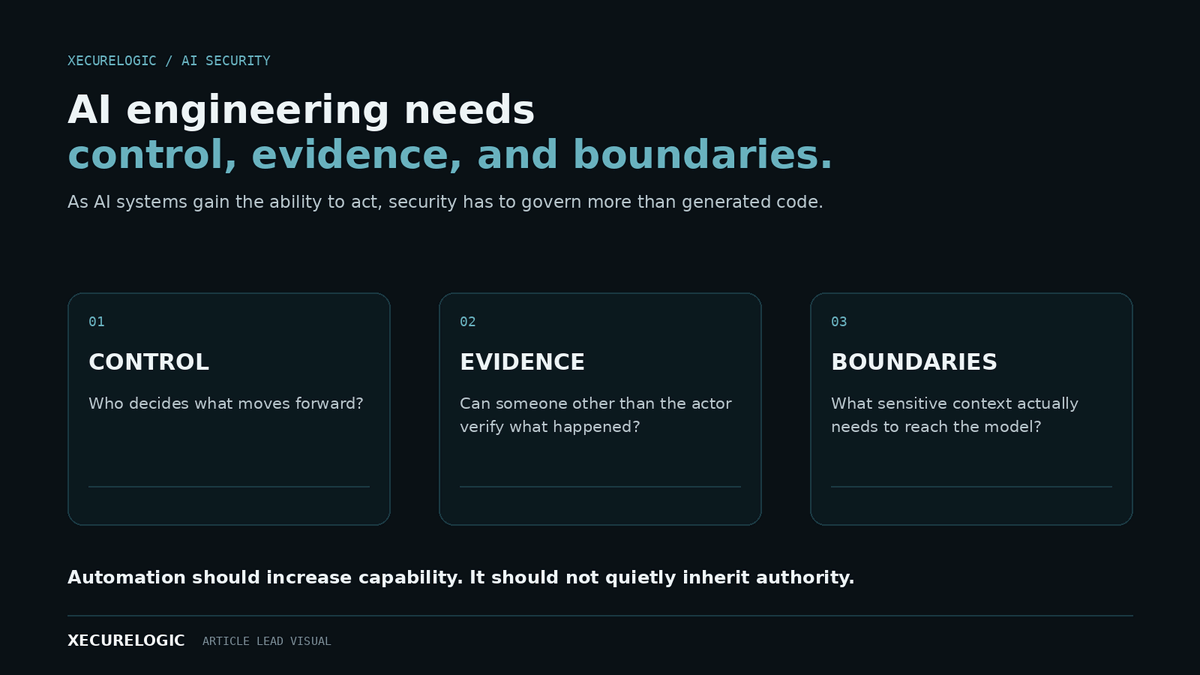
Three questions for AI-assisted engineering: who controls what moves forward, what independent evidence exists, and what sensitive context actually needs to reach the model.
Capability is not authority
A coding agent may be capable of changing a deployment file, accessing a repository, running a command, calling an external service, or performing a sequence of actions across a development environment.
Capability does not automatically imply permission.
Traditional software environments already separate what a system can do from what it is authorized to do. We use access controls, approval workflows, separation of duties, code review, protected branches, logging, and release gates because useful systems can still make harmful changes.
AI should not get a special exemption from that principle.
A system can sound confident and still be wrong.
It can explain why an action is safe and still misunderstand the environment.
It can report that a task is complete without independently proving that the result satisfies the organization’s requirements.
One principle we keep returning to at XecureLogic is simple:
AI can write the code. It shouldn’t get to decide it’s done.
Automation should increase capability.
It should not quietly inherit authority.
Three boundaries are becoming increasingly important
As organizations give AI systems more access to engineering environments, three architectural questions deserve more attention.
1. Who controls what moves forward?
Human oversight is often described as an instruction:
Ask for approval before doing anything dangerous.
That can be useful guidance, but guidance is not the same thing as control.
The more important question is whether there is an independent boundary that determines what is allowed to continue when the consequences matter.
The AI may propose an action.
It may explain the action.
It may strongly recommend the action.
But the decision to proceed should remain independently controllable.
Persuasion is not a pass.
This matters more as coding agents move from generating suggestions to executing multi-step workflows.
2. Can we independently inspect what happened?
When a human engineer changes a production system, mature environments usually leave evidence.
There may be commits, approvals, build records, deployment events, authentication records, tickets, logs, and other artifacts that help answer basic questions:
- What happened?
- When did it happen?
- What system initiated it?
- What was the result?
- Was the action expected?
- Can someone other than the actor inspect the record?
AI-assisted engineering should not reduce that visibility.
If anything, increasing automation makes independent evidence more important.
An AI-generated summary of its own activity can be useful context. It should not necessarily be the only source of truth about that activity.
The architectural idea is straightforward: allow AI tools to work in the engineering environment while maintaining a separate, inspectable record of the activity that matters.
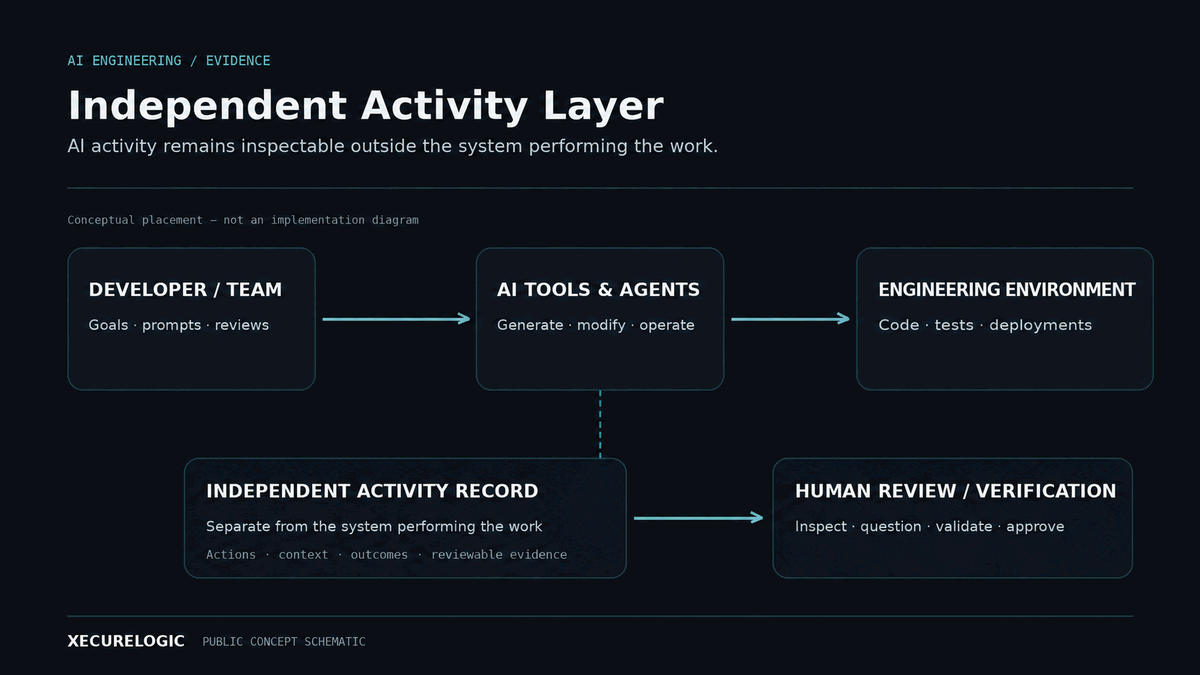
An independent activity layer sits alongside the AI-assisted engineering workflow, so the system performing the work is not the only system describing what happened.
The important part of this diagram is not a particular implementation.
It is the separation.
The system performing the work should not be the only system capable of describing what happened.
NIST has similarly highlighted the importance of identification, authorization, auditing, and non-repudiation for software and AI agents, while separate NIST work has emphasized traceability and evidence for agent decisions and tool use.[3][4]
3. What information actually needs to reach the model?
The other boundary is data.
Developers increasingly use AI systems with material that may include source code, internal documentation, tickets, architecture notes, logs, configuration, and operational context.
The security question should not simply be:
Are we allowed to use AI with this?
A better question is:
What information is actually necessary for this task?
Those are different questions.
A useful AI workflow may need context without needing every sensitive detail contained in the original source.
That suggests another architectural boundary: a layer between internal information and the AI system whose purpose is to reduce unnecessary exposure.
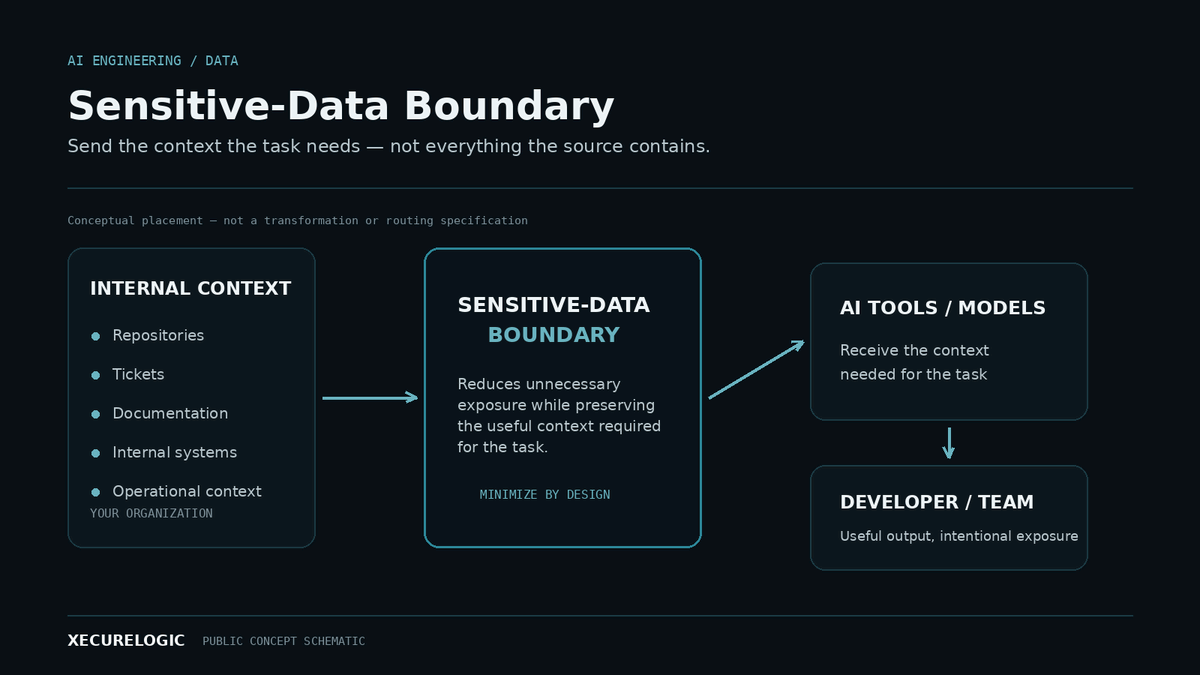
A sensitive-data boundary sits between internal context and AI tools, reducing unnecessary exposure while preserving the context the task requires.
The goal is not to claim that every workflow can or should be sanitized automatically.
Some tasks genuinely require sensitive context.
Others do not.
The objective is to make that distinction deliberate.
This is an extension of least privilege: not only which systems can an agent access, but which information is actually required for the task?
These are architecture problems, not prompt problems
There is a temptation to solve every AI security problem with better instructions.
Tell the agent not to expose secrets.
Tell it not to perform destructive actions.
Tell it to ask before making a risky change.
Tell it to accurately summarize what it did.
Those instructions can still be useful.
But instructions operate inside the system whose behavior we are trying to constrain or verify.
Security engineering has traditionally relied on stronger boundaries than that.
Access control is outside the user.
Code review is outside the code author.
A firewall is outside the application.
An audit record should not depend solely on the component being audited.
The same architectural thinking should apply to AI agents.
The next phase of secure development
AI-assisted development is not going away.
Nor should it.
The defensive upside is real as well. Google described in September 2026 how it is using agentic methods to scan infrastructure code and assist with vulnerability remediation at scale.[5]
The objective should not be to slow AI down until it behaves like yesterday’s tooling.
The objective should be to build environments where increased capability does not require surrendering control.
That means thinking beyond model quality and asking harder systems questions:
Who has authority?
What evidence exists?
What data crosses the boundary?
Those are familiar security questions.
AI simply makes them urgent again.
At XecureLogic, we have been spending a lot of time exploring these boundaries: human control over automated work, independently inspectable activity, and ways to use AI while reducing unnecessary exposure of sensitive information.
There is more coming from us in this area.
For now, the principle is enough:
AI can write the code.
It shouldn’t get to decide it’s done.
Sources
- [1] Google Threat Intelligence Group, “GTIG AI Threat Tracker: From Prompting to Autonomy – The Evolution of Adversarial AI,” September 8, 2026.
https://cloud.google.com/blog/topics/threat-intelligence/from-prompting-to-autonomy-the-evolution-of-adversarial-ai - [2] NIST / CAISI, “CAISI Issues Request for Information About Securing AI Agent Systems,” January 12, 2026.
https://www.nist.gov/news-events/news/2026/01/caisi-issues-request-information-about-securing-ai-agent-systems - [3] NIST NCCoE, “Accelerating the Adoption of Software and Artificial Intelligence Agent Identity and Authorization,” February 5, 2026.
https://csrc.nist.gov/pubs/other/2026/02/05/accelerating-the-adoption-of-software-and-ai-agent/ipd - [4] NIST, “Building Measurement Probes into Agentic AI Ecosystems,” April 7, 2026.
https://www.nist.gov/news-events/events/2026/04/nist-information-technology-laboratory-ai-webinar-series-building - [5] Google Cloud, “Changing the game: Using agentic AI to secure infrastructure code,” September 18, 2026.
https://cloud.google.com/blog/topics/systems/using-ai-agents-to-secure-google-infrastructure/